Donor Wall Studio · buyer guide
Naming tiers across multiple donor walls
For worldwide Donor Wall Studio orders, use the recognition program’s approved tier names consistently across donor walls, then place each building’s local context in a separate field. Different dimensions can justify different layouts without creating a new donor category. Confirm category membership and display names through the organization’s designated reviewer.
Reviewed 2026-09-05 · AI-assisted editorial review. General buying guidance; illustrative scenarios are not customer case studies. Images are AI-generated concepts.
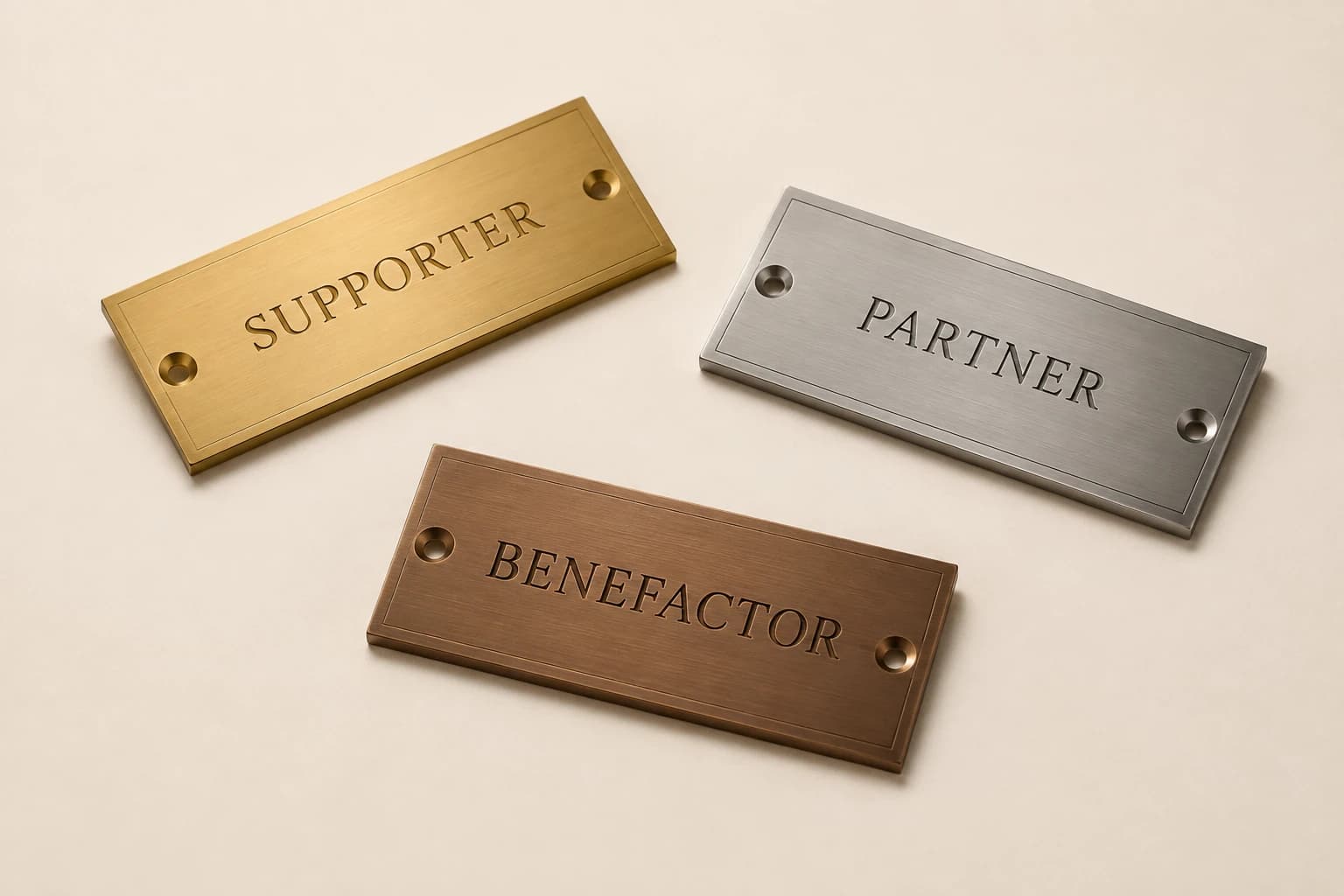
A donor tier should have an approved name and meaning before it becomes a heading on several walls. Ask the development team whether the tier reflects a campaign, a giving society, a historical commitment or another authorized recognition approach. The designer should receive the approved display category rather than calculate eligibility from donation amounts. A label that sounds attractive in one building can imply a different promise when repeated elsewhere. Record the program-level definition privately and the exact public heading separately. If the same donor appears at more than one location, ask whether the recognition is intentionally repeated or tied to a particular project. Do not assume a central donor database automatically means every name belongs on every wall.
Impact Signs discusses future names and recognition categories.
Sources: Impact Signs: 4 Steps to Creating a Memorable Donor Recognition Display
How do you separate the common tier name from local context?
Use a master field for the approved tier heading and a local field for the building or campaign context. A hospital wing, a community center and an administrative office may need different introductory text even when they share one recognition society.
Show how those fields work together in each layout. Avoid adding a location nickname inside the tier name merely to make one wall feel local; that can create an unintended second category. If local adaptation is authorized, document the exact variant and its scope. The goal is consistency of meaning, not necessarily identical proportions or identical surrounding text on every wall. A common program can accommodate distinct spaces without losing control of its public terminology.


How do you review donor names within the correct category?
Give each location a list of approved display names and assigned tiers, then have the development owner review the pairing. Correct spelling under the wrong heading is still an inaccurate recognition record. Keep preferred public names, joint names and anonymous recognition choices exactly as approved.
Do not infer family relationships or combine similar organization names to make the list shorter. If a donor changes category, determine whether the update affects one campaign wall or the full program. The worksheet should identify the affected locations so a correction is not completed at one building while an inconsistent version remains elsewhere. Keep confidential contribution details outside the artwork file; the public category assignment is the production input.
How do you let layout vary without creating a new hierarchy?
Compare actual-size heading and name treatments for each wall. A narrow wall may require more rows, while a broad lobby may use a different arrangement. Those spatial differences should not accidentally make the same tier appear more prestigious at one location.
Ask the organization to approve the visual hierarchy across the set, including type size relationships, spacing and any category separators. Use the same sample long name in each proof to test readability under comparable conditions. If a location cannot accommodate the approved hierarchy, consider a revised layout or scope rather than compressing one tier until it becomes difficult to read. The installer and facilities reviewer still need to confirm each site’s physical proposal separately.
How do you handle a tier rename as a coordinated change?
If the organization renames a giving society, decide whether historical walls retain the earlier title or receive an authorized update. A program rename does not automatically settle the treatment of completed campaign records. Inventory the locations, headers and companion materials that use the term.
Ask the development owner to approve the exact replacement wording and the facilities owner to review the physical change at each site. Keep a transition record so staff can explain why two versions may temporarily coexist. Avoid overwriting the original proof without preserving its historical meaning. The change should be deliberate and traceable, especially when the earlier name formed part of donor communications or a completed dedication.
Check the shared tier and local building lines
Load the fictional example, then replace its inputs with the reviewed details for your project.
Method: Count visible characters including spaces and punctuation on each entered line; compare each length with the user-entered line budget. Text counts do not establish physical fit.
Build your plan
Counts include spaces and punctuation. Character count cannot establish physical fit: font, script, layout, material and engraving area require a proof at actual size.
Use the article’s example files
Sample rows are illustrative and are not production instructions. Replace their assumptions, keep private records separately and complete the approval fields before using the sheet for a real order.
How do you maintain one master with location-specific releases?
Store the approved tier wording in one controlled master, but release a separate location proof showing the actual names and arrangement. A master label alone cannot approve every wall’s contents. Give each release a revision and a designated reviewer, then record installation completion by location.
When adding a new wall, copy the approved terminology from the master rather than retyping it from a photograph. Check whether the program definition has changed before reusing a historical layout. This approach preserves a common language while acknowledging that each building has its own dimensions, donor list and installation state. It also makes a later correction easier to target without implying that the whole portfolio of walls was updated at once.

How do you review names that cross a local category boundary?
Imagine a fictional donor recognized in one building for a completed campaign and in another for a current giving society. The same public name may legitimately appear under different headings because the two programs have different approved scopes. The coordinator should preserve that explanation in the private recognition record rather than forcing the walls to match mechanically.
Now consider the opposite situation: both buildings belong to the same program, but a local spreadsheet assigned the donor to a different tier by mistake. That discrepancy needs the development owner’s correction before artwork release. The useful review question is whether the difference is authorized and meaningful, not whether every repeated name looks identical everywhere. Provide the designer with the final category assignment for each location after this review. The artwork team should not be asked to settle a program-policy question by choosing whichever heading has more space in the layout.
How does this illustrative text proof work?
In a fictional organization, two buildings use the approved heading Community Partners. One local draft changes it to Community Champions for visual variety. The coordinator checks the recognition program and finds that no new tier was authorized, so the common heading is restored.
The local building name remains in a separate introductory line. The design can then differ in width and row arrangement without changing what recognition category the donors appear to occupy. The local building line in this fictional proof is West Hall. For a fictional two-line heading, enter Community Partners and West Hall. Community contains nine characters, the separating space adds one and Partners contains eight, making eighteen on the first line. West Hall contains nine characters including its space. The total is 27 across two lines, with a longest line of eighteen; both are within a chosen 24-character budget. The first line preserves the common tier vocabulary, while the second supplies a local building context. This checks text length only, not program eligibility or physical layout.
Shared tier vocabulary or Campaign-specific vocabulary: which fits the intended recognition?
Shared tier vocabulary can keep one recognition program understandable across several buildings. Campaign-specific vocabulary can work when the organization deliberately defines separate programs. Compare the approved meaning of each heading before choosing visual variety; a local subtitle can distinguish the building without silently promoting donors into a newly invented category.
| Option | Shared tier vocabulary | Campaign-specific vocabulary |
|---|---|---|
| Best reason to choose it | Use this when the organization wants one recognition program understood consistently across several locations. | Use this when distinct campaigns require different recognition categories and the organization approves that distinction. |
| Main review question | Does each heading have the same approved meaning and eligibility basis wherever it appears? | Could a visitor mistake a local campaign label for the same program tier used elsewhere? |
| What to specify | Maintain a controlled master of public tier names and separate approved donor lists for each location. | Specify the campaign context, exact local heading and any explanation needed to distinguish the program clearly. |
| Later change | A master tier rename requires review of affected location releases and any historical campaign displays. | A campaign-specific heading should retain its approved meaning even when another building adopts different vocabulary. |
What should the organizer confirm before ordering?
Confirm the program’s tier vocabulary and each building’s donor membership separately. A shared heading can support consistent recognition while local names and dimensions differ. The order needs a master meaning for the category and distinct location releases, especially when someone proposes a new heading or requests a later coordinated rename.
What should a multi-wall tier-naming quote include?
Ask Donor Wall Studio to separate the common heading artwork from location-specific layouts, donor components and shipping or installation scope. Request the applicable minimum or range for the proposed group. A shared tier name does not imply identical wall dimensions or identical donor lists, so each location still needs its own approved release.
Should every building display the same donor names?
Follow the organization’s approved recognition scope for each location. Shared tier vocabulary can describe consistent categories without requiring identical membership on every wall. The development reviewer should confirm which donors belong in each local release, and the designer should not copy a list from another building merely because its heading matches.
Can a local team rename a tier for visual interest?
Treat a proposed rename as a program decision, not a stylistic edit. Community Partners and Community Champions may imply different categories to readers. Ask the organization to approve the intended meaning before changing the heading; use a separate building subtitle when the real goal is simply to identify the local display.
How does the Community Partners example separate local context?
The fictional walls retain the approved Community Partners heading, while West Hall appears as a separate building line in the text exercise. The two fields have different roles. The character count helps review their line lengths without deciding donor eligibility or authorizing a new category for the local wall.
What if the organization later changes the tier names?
Create a coordinated change record identifying affected headings, donor placements and location releases. Ask the program owner whether historical displays should change or preserve an earlier campaign’s terminology. A revised master heading should not automatically overwrite every wall without checking the recognition context and the actual components that would need replacement.
Sources and scope
The sources below support the cited technical details. The ordering workflows are editorial recommendations. Your project specification, price and schedule are established in the written quote and approved proof.
- Impact Signs: 4 Steps to Creating a Memorable Donor Recognition Display · checked 2026-09-05
Which buying guide should you read next?
All buying guidesFor worldwide Donor Wall Studio orders, choose updateable donor tiles when the recognition program needs a defined process for additions or corrections. Choose permanent lettering for an approved list intended to remain fixed. Ask how one specific name would change before approving the wall’s initial appearance and future capacity.
For worldwide Donor Wall Studio orders, choose a personal donor gift for an identified recipient and building recognition for an approved public display. Keep private gift wording and addresses separate from the public name list. Ordering both can support one appreciation program while requiring different consent, location and delivery decisions.