Donor Wall Studio · buyer guide
Updateable donor tiles versus permanent lettering
For worldwide Donor Wall Studio orders, choose updateable donor tiles when the recognition program needs a defined process for additions or corrections. Choose permanent lettering for an approved list intended to remain fixed. Ask how one specific name would change before approving the wall’s initial appearance and future capacity.
Reviewed 2026-09-05 · AI-assisted editorial review. General buying guidance; illustrative scenarios are not customer case studies. Images are AI-generated concepts.
An updateable donor wall serves a different program from a completed dedication whose list is expected to remain fixed. Ask the development team whether new names, changed recognition categories or corrected display names are likely to be added after installation. Do not treat future growth as a vague request to leave some room. Identify the kinds of changes the organization wants the construction to accommodate. Permanent lettering may suit a historically complete list, while individually replaceable tiles may suit an ongoing campaign. Neither choice settles donor eligibility or guarantees that every future addition will fit. Write the intended update process before selecting the visual arrangement so a pleasing initial design does not create an unworkable maintenance task.
Impact Signs discusses future names and recognition categories.
Sources: Impact Signs: 4 Steps to Creating a Memorable Donor Recognition Display
How do you define what updateable means in the proposal?
A display can look modular without having components that are easily reordered or replaced. Ask the proposed fabricator to identify the actual replaceable part, its dimensions, the attachment arrangement and what information will be needed for later orders. Distinguish a removable name tile from a panel that must be replaced as a whole.
If blanks are proposed, confirm whether they are finished fillers, unfinished stock or simply empty positions. Do not assume that future engraving can be completed on a purchased blank without a reviewed process. Keep the response with the drawing. The useful promise is a specific construction and a documented replacement method, not a general description such as flexible or expandable.


How do you compare the visual rhythm after additions?
Look at a second layout showing a plausible later state, not only the first installation. For tiles, test a long organization name, a joint donor name and an unassigned position within the proposed grid. For permanent lettering, ask how an additional line would relate to the existing spacing and hierarchy.
A wall that looks balanced with the first cohort may need a different plan when one category grows faster than another. Use fictional names in the design exercise rather than implying that expected gifts have already been received. The development team should approve which positions represent current recognition and which are merely planned capacity. A future-state drawing helps expose those distinctions without committing to unconfirmed donor names.
How do you assign responsibility for routine changes?
Name the person who approves a donor’s display text and the person who arranges the physical update. These may be different people. Development staff can authorize a corrected name, while facilities staff coordinate access and the approved installation method. Record how the two roles hand off the request.
If the design requires specialist work for every update, include that dependency in the comparison rather than assuming a staff member can swap a component. For a permanent inscription, a correction may involve a different proposal from an ordinary addition. Ask how that situation would be handled before selecting the construction. The organization should understand the practical burden of keeping the display accurate after the unveiling team has moved on.

How do you keep replacements consistent without promising a perfect match?
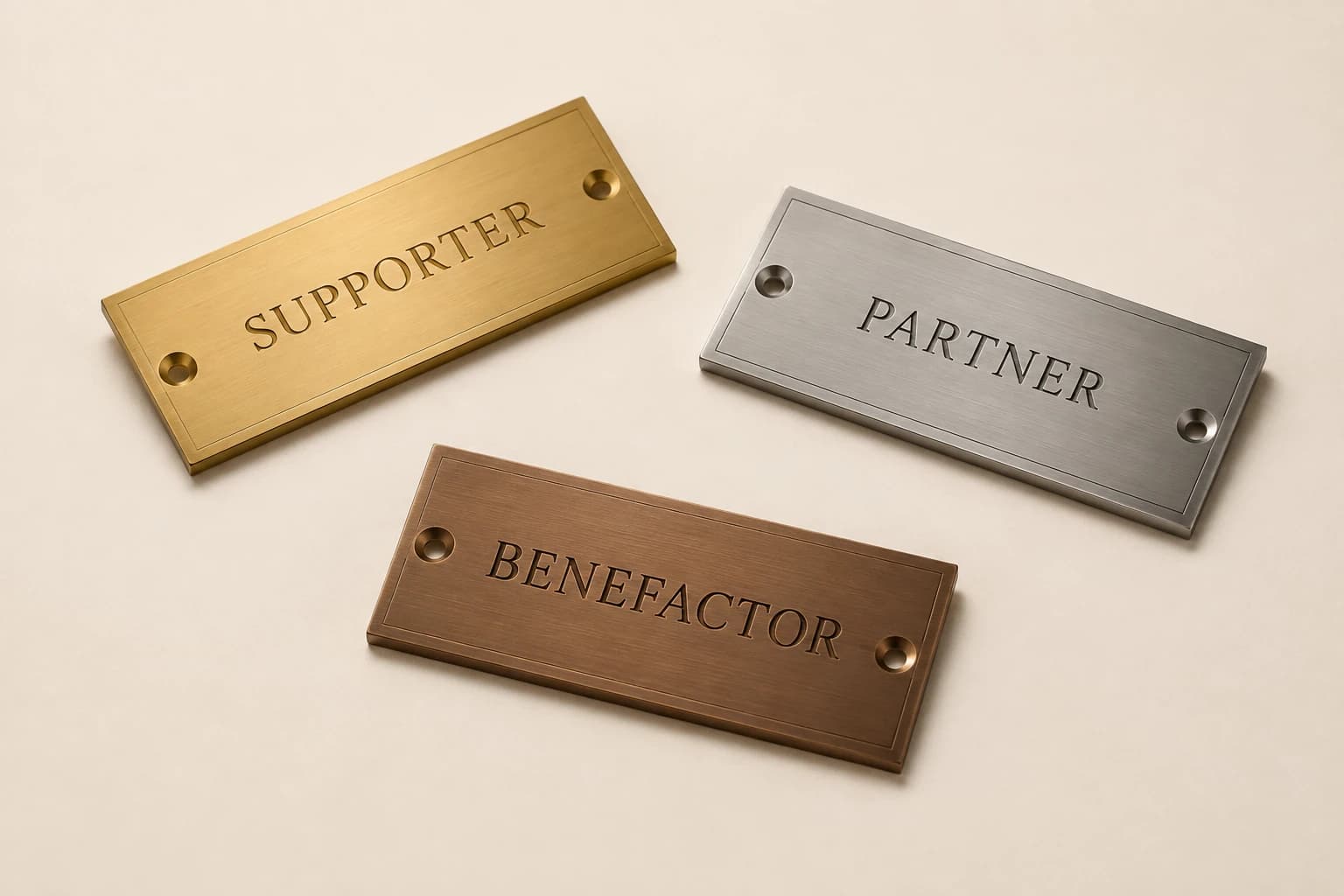
Retain the approved type treatment, component dimensions, material description and finish reference. A future request can then ask for compatibility against known information. Avoid promising that a later batch will be visually indistinguishable from an aged installation; ask the supplier to explain the proposed match and review it in context.
If the wall’s appearance changes over time, the organization may prefer a deliberate refresh of a group rather than one conspicuous replacement. That choice belongs in a specific update proposal. Photograph the installed arrangement for location reference, but do not rely on the image alone to reconstruct measurements or color. The reorder record should explain both the component and its intended position.
Model a donor correction versus a new addition
Load the fictional example, then replace its inputs with the reviewed details for your project.
Method: Add current and reserved positions, multiply rows by columns, and compare the totals. Slot arithmetic does not count physical blank fillers or determine installation dimensions.
Build your plan
Counts layout slots only. Plate dimensions, gaps, headers, attachment points and usable wall area need a measured drawing.
Use the article’s example files
Sample rows are illustrative and are not production instructions. Replace their assumptions, keep private records separately and complete the approval fields before using the sheet for a real order.
How do you separate capacity from physical pieces purchased now?
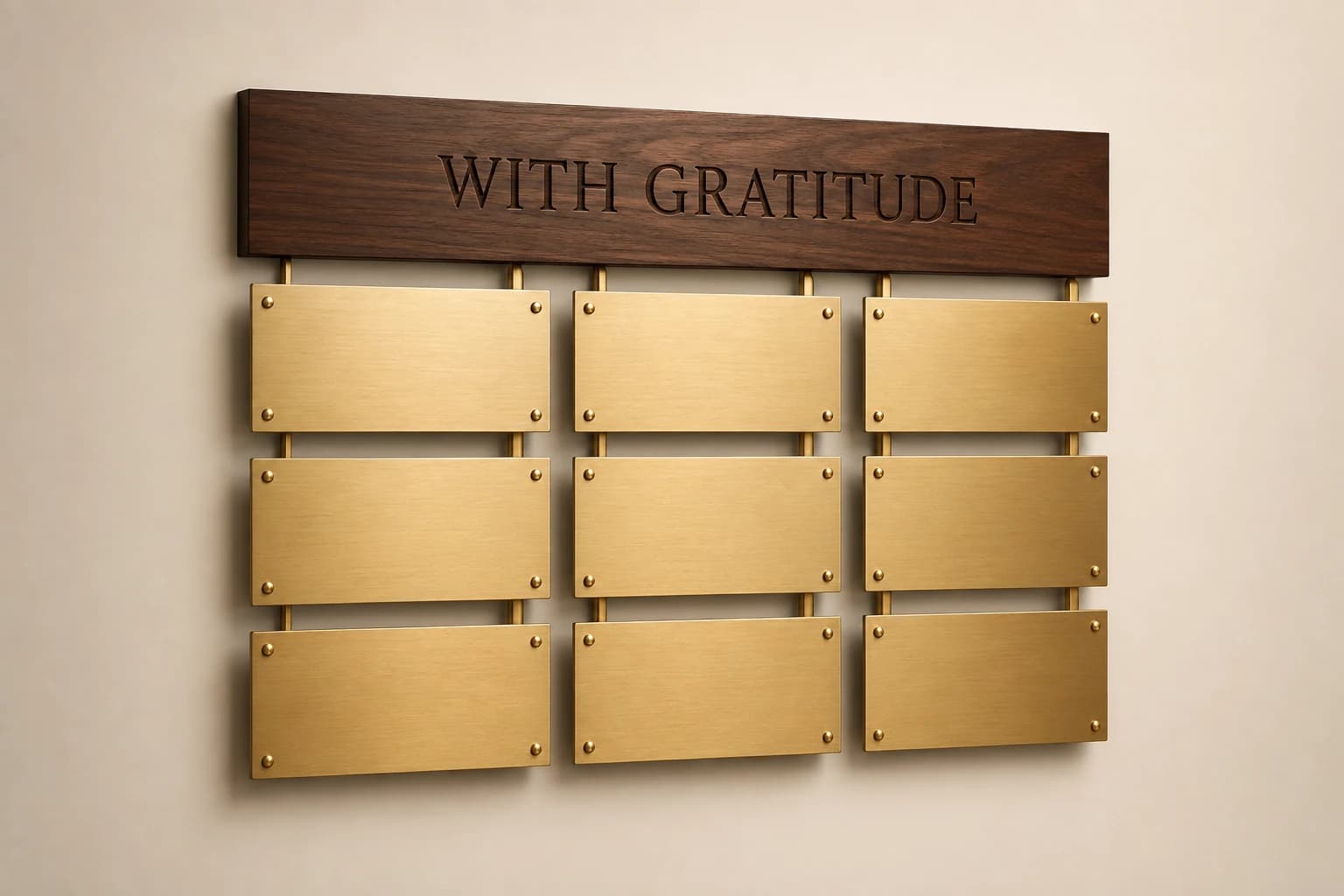
A grid can contain planned positions without every position requiring a finished tile in the first order. Decide whether empty areas remain open, use removable blank fillers or carry an approved campaign message. Count those physical components separately from the number of current donor names.
If the organization purchases spare tiles, record their intended use and storage owner. Reserved capacity should not be described publicly as confirmed donor recognition. At receiving, compare the current-name pieces, blanks and spare components against their own rows. This is especially important when the same visible size is used for several statuses. A complete delivery is one whose component types match the approved construction, not merely one with the expected total number of rectangles.
How do you ask for one concrete replacement exercise?
Before selecting an updateable system, give the proposed supplier a fictional correction: one approved name in the middle of the second row must be replaced while neighboring names remain unchanged. Ask which physical part would be ordered, what reference information is needed and who performs the approved change.
Then test a different situation in which a new donor is added to a category that has no remaining allocated position. These exercises reveal different limitations. A replaceable tile may solve the first without solving the second. A fixed inscription may require a broader revision in either case. Record the responses as part of the proposed construction rather than advertising them as universal capabilities. If the replacement process depends on retaining a drawing, finish reference or special component, assign responsibility for keeping it. The organization should know how an ordinary future correction would be requested before the original installation team disperses. This practical exercise is more informative than asking whether the wall is simply described as updateable.
How does this illustrative planning example work?
A fictional ongoing campaign needs an updateable wall for sixteen approved names and four reserved future positions. The coordinator asks for a replacement exercise and an addition exercise before selecting the construction, keeping current recognition separate from future capacity. For an illustrative updateable-tile exercise, sixteen current names and four reserved future positions use twenty positions in a four-row, six-column layout.
The calculator reports 24 slots and four unassigned positions. Now consider a correction to one current donor name: replacing that tile changes neither the sixteen-current count nor the layout capacity. A new approved donor, by contrast, changes the current allocation and must be assigned a position. These are different update requests even though either may involve ordering one finished tile.
Updateable tiles or Permanent lettering: which fits the intended recognition?
Updateable tiles support a proposed component-change process, while permanent lettering treats the approved inscription as a more fixed arrangement. Compare a real correction and addition exercise for each construction. Available positions, replacement pieces and the organization’s authority to recognize another donor remain separate decisions even when the initial designs look similar.
| Option | Updateable tiles | Permanent lettering |
|---|---|---|
| Best reason to choose it | Use this for an ongoing program that needs a defined process for additions and corrections. | Use this when the organization approves a stable historical list and accepts the implications of later changes. |
| Main review question | Which actual component is replaceable, and who can carry out the approved update? | How would a corrected or newly approved name be handled within the proposed layout? |
| What to specify | Specify tile dimensions, current and blank quantities, location identifiers and the documented reorder process. | Specify the complete approved list, spacing, hierarchy and a project-specific approach to any future alteration. |
| Later change | A corrected name replaces an existing tile; a new approved donor changes allocation and requires a position decision. | A future name addition needs a specific proposal for the fixed inscription rather than an assumed one-tile replacement process. |
What should the organizer confirm before ordering?
Ask how one correction and one new donor would be handled before choosing the wall construction. Those changes can each involve one tile while affecting the recognition schedule differently. Keep replacement scope, reserved capacity and the organization’s update owner visible so a future request starts from a known component and program record.
What should an updateable donor-wall quote include?
Ask Donor Wall Studio to identify the initial components, personalization, reserved capacity, installation interface and shipping, plus the applicable range or minimum. Request a separate example of the proposed later tile replacement or addition scope. An initially economical wall can still create an unclear maintenance task if future work is described only as easy to update.
Does correcting one donor name consume another position?
A correction can replace an existing tile without changing the number of recognized donors or allocated positions. A newly approved donor requires an addition decision and a position assignment. Keep those request types separate in the update record so the same one-piece purchase quantity does not conceal two different changes to the program.
Are blank tiles the same as reserved positions?
No. A reserved position is an allocation in the layout; a blank tile is a physical component. The organization may reserve space with a blank installed, leave it open or use another reviewed arrangement. Record the selected construction and any stored spares separately instead of assuming the capacity figure describes the initial purchase.
Can a future replacement be guaranteed to match exactly?
Ask for a specific proposed match against the retained component and finish references. Do not assume a photograph or old product name establishes a perfect later match. Existing pieces may have changed in appearance, and the current proposal needs review. The organization can compare a single replacement with a broader approved refresh when necessary.
Who should own routine donor-wall updates?
Name the person responsible for the current recognition list, position map and replacement requests. That owner should obtain donor-name approval and retain the final component references. A volunteer or facilities handoff should transfer those records, allowing the next coordinator to distinguish a spelling correction, a new donor and a change in the recognition program.
Sources and scope
The sources below support the cited technical details. The ordering workflows are editorial recommendations. Your project specification, price and schedule are established in the written quote and approved proof.
- Impact Signs: 4 Steps to Creating a Memorable Donor Recognition Display · checked 2026-09-05
Which buying guide should you read next?
All buying guidesFor worldwide Donor Wall Studio orders, count approved donor names, reserved positions and physical blank fillers separately. A vacant slot is space, while a filler is an ordered component. Decide which unused positions receive blanks now, which remain open and whether any additional stock has an approved later use.
For worldwide Donor Wall Studio orders, brief the donor wall with a measured display area, component dimensions, gaps and a position map for the installer. A row-and-column count establishes capacity only. Keep the overall wall, proposed arrangement and attachment decisions distinct so the final handoff describes the actual installation location.